



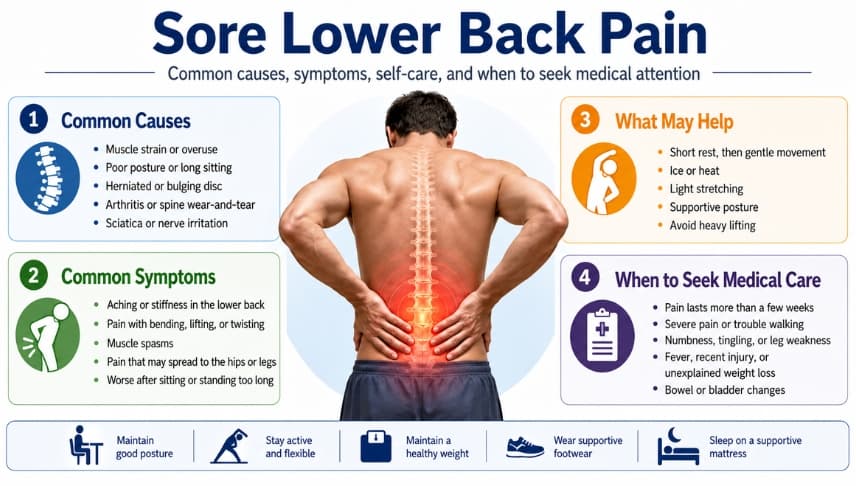
Waking up with a sore lower back can make daily tasks like standing, driving, lifting groceries, sitting at work, or getting out of bed feel more difficult than usual. Pain may come from muscle strain, poor posture, or mechanical stress, but persistent, radiating, or worsening symptoms may need closer evaluation. Dr. Rao K. Ali evaluates Dallas and North Texas patients with lower back, spine, and nerve-related pain concerns. Low back pain may involve muscles, ligaments, discs, joints, nerves, or spinal structure. Symptoms can feel dull, sharp, aching, burning, activity-related, or radiating into the buttock or leg, depending on the underlying cause. A sore lower back usually means there is irritation, strain, inflammation, or mechanical stress in the lumbar region. Common causes include muscle strain, ligament strain, poor posture, prolonged sitting, disc irritation, arthritis, sciatica, spinal stenosis, or chronic vertebral pain. Because the lower back supports standing, bending, lifting, walking, and twisting, it can become sore from daily stress or medical conditions. A sore lower back may feel different for each patient. Some people notice a dull ache, stiffness, tightness, burning pain, sharp pain, muscle spasms, or pain that travels into the buttock or leg. Acute pain may last days to weeks, while chronic pain lasts over three months. Persistent, radiating, or function-limiting pain may need a detailed spine evaluation. A sore lower back is not a diagnosis by itself. It is a symptom. The cause may be simple, such as muscle strain after lifting, or more complex, such as a herniated disc, spinal stenosis, or chronic vertebral pain. A physician evaluation is the safest way to determine the likely source when symptoms persist, worsen, or spread. Muscle or ligament strain is a common cause of lower back soreness. It may happen after heavy lifting, sudden twisting, exercise, yard work, moving furniture, or sitting too long. Pain may cause tightness, stiffness, aching, or spasms. Mild strains often improve with time, but recurring or radiating pain should be evaluated. Poor posture and long sitting can place extra stress on the lumbar spine. Long commutes, desk work, remote work, poor chair support, slouching, or low screen height may trigger soreness. Lumbar support, movement breaks, walking, and better workstation setup may help. A bulging or herniated disc can irritate nearby lumbar nerves. Pain may stay in the lower back or travel into the buttock, hip, thigh, calf, or foot. Symptoms may worsen with bending, sitting, coughing, sneezing, or lifting. Sciatica is pain caused by irritation or compression of the sciatic nerve or related nerve roots. It often starts in the lower back or buttock and travels into the leg. Pain may feel sharp, burning, electric, or shooting, sometimes with numbness or weakness. Spinal stenosis means narrowing around the spinal canal or nerve spaces. In the lower back, it may cause back pain, leg pain, cramping, numbness, tingling, or weakness. Symptoms often worsen with standing or walking and may improve with sitting or leaning forward. Arthritis and degenerative disc disease may cause recurring lower back pain, morning stiffness, reduced flexibility, and activity-related flare-ups. These conditions can affect discs, facet joints, or other lumbar spine structures. Symptoms vary, so individualized evaluation is important. Chronic vertebral pain refers to long-lasting or recurring pain linked to spine structures. It may involve discs, facet joints, vertebral endplates, or other pain sources. Pain lasting over three months, returning often, or limiting daily activity may need deeper evaluation. Not all lower back pain comes from muscles or the spine. Less common causes may include kidney stones, infection, fracture, inflammatory disease, pelvic conditions, or cancer-related problems. Severe, unusual, traumatic, fever-related, or unexplained pain should be medically evaluated. A sore lower back may be serious if it follows a major fall or accident, causes leg weakness, numbness, fever, unexplained weight loss, severe night pain, loss of bladder or bowel control, or pain that spreads below the knee and keeps worsening. These symptoms should be evaluated urgently. Red flags include: New bladder or bowel control problems Numbness in the groin or saddle area Progressive leg weakness Fever or chills with back pain Unexplained weight loss History of cancer Recent trauma or fall Severe pain after osteoporosis or long-term steroid use Pain that wakes the patient at night and does not improve with rest Severe radiating pain below the knee New numbness or tingling in both legs Sore lower back pain may stay localized, sciatica often travels into the leg, and chronic back pain lasts or returns for months. A sore lower back is usually localized to the lumbar region. It may feel aching, tight, stiff, or tender. It may be muscular, mechanical, posture-related, or linked to joints or discs. Localized soreness without leg symptoms is often less concerning than pain with neurological changes. Still, persistent soreness that limits daily life deserves medical attention. Sciatica Pain is different because it often radiates into the buttock or leg. It may involve nerve compression or irritation. Symptoms may include numbness, tingling, burning pain, shooting pain, or weakness. Sciatica can be caused by a herniated disc, spinal stenosis, degenerative changes, or other conditions affecting the nerve roots. Evaluation matters when symptoms persist, worsen, or affect walking. Chronic Back Pain generally refers to pain lasting longer than three months. It may involve recurring flare-ups, stiffness, sleep disruption, work limitations, or reduced mobility. A Dallas patient with chronic back pain may need more than short-term self-care. The evaluation may include history, physical exam, neurological testing, prior treatment review, and imaging when medically appropriate. This section is general education and is not a diagnosis. Patients should seek medical advice if pain is severe, worsening, traumatic, or associated with red flags. For mild lower back soreness, gentle activity often helps. Short walks, light movement, and avoiding prolonged bed rest may support recovery. Patients should avoid movements that sharply worsen pain. Cold therapy may help early soreness after strain, especially when there is irritation or inflammation. Heat may help with muscle tightness, spasms, and stiffness. Some patients alternate both. Heat or cold should not be applied directly to the skin, and patients with reduced sensation, circulation problems, or certain medical conditions should ask a clinician before using temperature-based therapy. Gentle stretching may help some patients with mild soreness. Common options include knee-to-chest stretch, cat-cow, child’s pose, and hamstring stretch. Stretching should not be forced. Sharp pain, worsening radiating leg pain, numbness, tingling, or weakness are reasons to stop and seek medical advice. Posture changes can reduce mechanical stress on the lumbar spine. Helpful adjustments may include lumbar support, proper chair height, screen-height correction, standing breaks, and keeping feet supported. Better lifting technique can reduce strain. Bend the knees, keep the load close to the body, avoid twisting while lifting, and ask for help with heavy objects. Repeated lifting with poor mechanics can trigger muscle strain, ligament strain, disc irritation, or recurring soreness. Do not rely only on home care if pain is severe, follows trauma, causes neurological symptoms, includes bladder or bowel changes, occurs with fever, or produces worsening leg pain. These symptoms require medical evaluation. Dallas patients should consider seeing a Spine Specialist when a sore lower back lasts more than a few weeks, keeps returning, limits walking or sleep, spreads into the leg, causes numbness or weakness, or does not improve with conservative care. A specialist can help determine if pain is muscular, nerve-related, disc-related, joint-related, or vertebral in origin. Diagnosis matters because the same symptom can come from different sources. Lower back pain may be related to muscle strain, facet joints, sacroiliac joints, discs, spinal nerves, spinal stenosis, arthritis, or chronic vertebral pain. A specialist evaluation may include a physical exam, neurological assessment, review of pain triggers, medication history, prior treatment review, and imaging review. Imaging such as X-ray, MRI, or CT scan may be considered when symptoms, exam findings, duration, or red flags support the need. Imaging is not always required for mild, short-term pain. Dr. Rao K. Ali evaluates Dallas and North Texas patients by first working to understand the pain pattern. This may include where the pain starts, if it stays in the lower back, if it travels into the buttock or leg, and if the patient has numbness, tingling, weakness, or muscle spasms. Patient history Pain location and pattern Functional limitations Walking, sitting, standing, and sleep impact Leg symptoms Neurological symptoms Prior treatments Medication history Imaging review Physical exam Conservative treatment review Discussion of if advanced diagnostics may be appropriate Treatment for a sore lower back depends on the suspected cause, symptom severity, medical history, and functional goals. This section is general education and should not be treated as a personal treatment plan. Conservative care may include activity modification, physical therapy, home exercise, posture correction, ergonomic changes, and anti-inflammatory strategies when medically appropriate. Physical therapy may focus on mobility, core strength, hip flexibility, movement mechanics, and safer return to activity. Home exercise should be individualized because the wrong movement can aggravate certain pain patterns. Over-the-counter medications may help some patients, but they are not safe for everyone. Risks can depend on kidney disease, stomach ulcers, heart conditions, blood thinner use, liver disease, age, pregnancy status, and other medications. Patients should follow medical guidance rather than assuming all pain relievers are safe. Some patients may benefit from targeted procedures depending on diagnosis. In interventional pain management, options may include epidural steroid injections, facet-related procedures, sacroiliac joint evaluation, or nerve-related treatments. These options are not appropriate for every patient and should not be presented as guaranteed relief. The purpose is to match treatment to the suspected pain generator and clinical findings. Most lower back pain is not surgical. However, some conditions require surgical evaluation, especially when there is progressive neurological deficit, severe nerve compression, structural instability, or red-flag symptoms. Patients with bladder or bowel changes, saddle numbness, or progressive weakness should seek urgent care. Dallas patients often deal with long commutes, sedentary work, physically demanding jobs, sports, and active family schedules. These daily demands can influence how lower back pain develops and how quickly it begins affecting work, walking, driving, sleep, or family responsibilities. North Texas patients may delay care until pain becomes persistent or function-limiting. A local physician can evaluate symptoms in context and coordinate care when needed. Patients from Dallas, North Dallas, Downtown Dallas, Oak Lawn, Lakewood, Preston Hollow, Highland Park, University Park, Richardson, Plano, Garland, Mesquite, Irving, Arlington, and surrounding North Texas communities may consider evaluation when lower back symptoms persist, radiate, or interfere with daily life. A sore lower back may be caused by muscle strain, ligament strain, poor posture, prolonged sitting, disc irritation, arthritis, sciatica, spinal stenosis, or chronic vertebral pain. Less common causes include infection, fracture, kidney problems, inflammatory disease, or cancer-related issues. Persistent or worsening pain should be evaluated. Mild soreness may improve within a few days to a few weeks, especially when related to strain or posture. Pain that lasts longer than expected, keeps returning, worsens, or spreads into the leg should be evaluated to rule out disc, nerve, joint, or vertebral causes. Yes. A sore lower back may be sciatica if pain travels into the buttock, hip, thigh, calf, or foot. Sciatica may also cause numbness, tingling, burning pain, or weakness due to irritation or compression of the sciatic nerve or related nerve roots. You should worry when lower back pain follows trauma, causes progressive leg weakness, includes bladder or bowel changes, produces saddle numbness, occurs with fever, causes unexplained weight loss, or wakes you at night without relief. These red flags need prompt evaluation. Cold therapy may help early soreness after strain or irritation. Heat may help tightness, spasms, and stiffness. Some patients use both at different times. Avoid direct skin contact, and seek medical advice if pain is severe, worsening, traumatic, or linked to numbness or weakness. Gentle walking can help mild lower back soreness by reducing stiffness and encouraging movement. Stop if walking worsens leg pain, numbness, tingling, weakness, or severe pain. Persistent walking-related pain may need evaluation for nerve or spinal stenosis-related causes. Patients with chronic back pain may see a primary care physician, spine specialist in Dallas, pain management specialist, or interventional pain management physician. Urgent care is needed for red flags like bladder or bowel changes, progressive weakness, saddle numbness, fever, or severe trauma-related pain. Yes. Poor posture can contribute to a sore lower back, especially with long sitting, driving, desk work, weak lumbar support, or poor workstation setup. Posture-related pain often feels like aching, tightness, or stiffness. Persistent pain may involve additional factors and should be evaluated if it does not improve. Yes. A herniated disc in the lumbar spine can cause lower back pain and may irritate nearby nerves. Symptoms may include radiating leg pain, numbness, tingling, or weakness. Pain may worsen with sitting, bending, coughing, sneezing, or lifting, depending on the disc and nerve involvement. Yes. Dr. Rao K. Ali evaluates patients with lower back pain, sore lower back symptoms, sciatica-like pain, and spine-related pain concerns in the Dallas and North Texas area. Patients should use verified contact details from the official listing or final published page before scheduling. Chronic vertebral pain is more specific than general lower back pain. It refers to persistent pain linked to structures of the spine or vertebral column, such as vertebral endplates, discs, facet joints, or nearby spine-related tissues. It may be one possible source of chronic lower back pain. Bring prior imaging reports, MRI or X-ray discs if available, a medication list, prior treatment records, physical therapy notes, injection history, symptom timeline, pain triggers, and details about numbness, tingling, weakness, or radiating leg pain. This helps the physician understand the full pattern.What Does a Sore Lower Back Usually Mean?
Common Causes of a Sore Lower Back
Muscle or Ligament Strain
Poor Posture and Long Sitting
Herniated or Bulging Disc
Sciatica Pain
Spinal Stenosis
Arthritis and Degenerative Disc Disease
Chronic Vertebral Pain
Less Common but Important Causes
When is a Sore Lower Back Serious?
Sore Lower Back vs Sciatica vs Chronic Back Pain
Sore Lower Back
Sciatica Pain
Chronic Back Pain
What Can Dallas Patients Try First for Mild Lower Back Soreness?
Stay Gently Active
Heat and Cold Therapy
Gentle Stretching
Posture and Workstation Changes
Safer Lifting Habits
When Not to Self-Treat
When Should You See a Spine Specialist for Lower Back Pain?
How Dr. Rao K. Ali Evaluates Sore Lower Back Pain in Dallas
Treatment Options May Depend on the Cause
Conservative Care
Medication Review
Image-Guided or Interventional Options
Surgical Referral When Needed
Why Local Evaluation Matters
Frequently Asked Questions
What causes a sore lower back?
How long should a sore lower back last?
Can a sore lower back be sciatica?
When should I worry about lower back pain?
Should I use heat or ice for lower back pain?
Is walking good for a sore lower back?
What kind of doctor should I see for chronic back pain?
Can poor posture cause a sore lower back?
Can lower back pain come from a herniated disc?
Does Dr. Rao K. Ali evaluate lower back pain in Dallas?
Is chronic vertebral pain the same as lower back pain?
What should I bring to a lower back pain appointment?