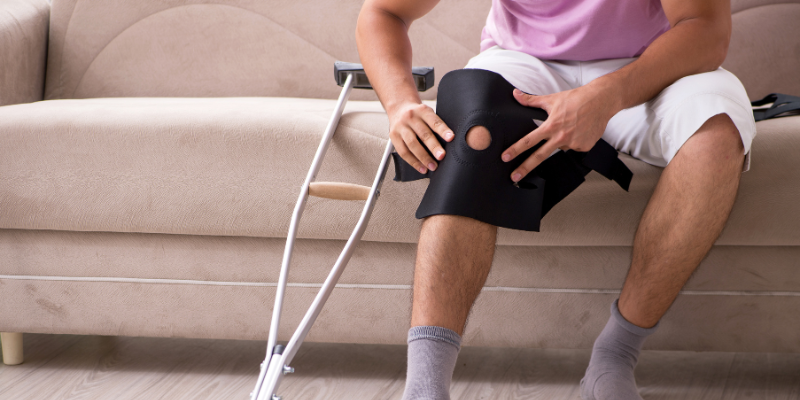
You twisted your knee during a basketball game. Your shoulder has been hurting for weeks after pitching. Or your ankle swelled up after a trail run. You have one question: Do I need a doctor, or can I treat this at home?
The answer depends on the injury. Many sports injuries heal without surgery, but some need medical attention right away. This guide from Dr. Rao K. Ali, a double board-certified pain physician and sports injury specialist in Dallas, explains evidence-based, non-surgical treatment options for athletes in Dallas, Plano, and throughout the Dallas-Fort Worth metroplex. You will learn what to do in the first 48 hours, which treatments actually work, and when to see a specialist.
A sports injury is damage to muscles, ligaments, tendons, or bones that happens during physical activity. The two main types are acute injuries (sudden trauma like a fall or twist) and chronic injuries (damage from repeated overuse over time). About 8.6 million sports injuries occur each year in the United States, according to national surveillance data.
Acute injuries happen in a single moment. You land wrong after a jump and feel immediate pain. Chronic injuries develop slowly. You ignore a small ache until it becomes a sharp pain every time you play. Both types respond well to non-surgical treatment when addressed early.
The most common sports injuries treated without surgery are ankle sprains, hamstring strains, rotator cuff tendinopathy, tennis elbow, runner’s knee, and Achilles tendinopathy. Research shows that over 80 percent of these injuries improve with conservative care including activity modification, physical therapy, and targeted injections.
In the first 48 hours after an acute sports injury, follow the PRICE protocol: Protection, Rest, Ice, Compression, Elevation. This replaces the older RICE protocol. Protection means using a brace or crutches to avoid further damage. Rest is temporary, not complete immobilization.
For most acute injuries, the first step in sports injury treatment in Dallas is the PRICE protocol.
Ice is for the first 48 to 72 hours. It reduces swelling, numbs pain, and limits internal bleeding. Heat is for chronic tightness and stiffness after the swelling has resolved – usually after 72 hours. Never apply heat to a fresh injury. It increases blood flow and makes swelling worse.
Seek medical attention the same day if you experience:
Inability to bear any weight on the injured leg or foot
Visible deformity or bone sticking out of position
Numbness or tingling that spreads down an arm or leg
Pain that is 8 out of 10 or higher despite rest and ice
Fever with joint swelling (possible infection)
A popping sound followed by immediate instability (knee gives out, shoulder slips out of socket)
Non-surgical sports injury treatment – medical care for musculoskeletal damage that does not involve cutting into the body. Options include physical therapy, medications, injections guided by ultrasound or X-ray, and regenerative medicine procedures like platelet-rich plasma (PRP).
Physical therapy is the foundation of non-surgical recovery. A physical therapist evaluates your movement patterns, strength, and flexibility. Then they prescribe exercises that rebuild function without re-injuring the tissue. Functional rehabilitation goes beyond basic range of motion. It trains your body to handle sport-specific movements – running, cutting, jumping, throwing – before you return to play.
Ultrasound is a handheld device that sends sound waves into the body to create a live image of muscles, tendons, and ligaments. When a physician uses ultrasound to guide an injection, they can see the needle enter the exact target. This is called ultrasound-guided injection. It is more accurate than injections based on touch alone.
Platelet-rich plasma (PRP) is made from your own blood. A nurse draws a small amount of blood, spins it in a machine called a centrifuge to concentrate the platelets, and then the physician injects the PRP into the injured tendon or ligament. Platelets release growth factors that may stimulate healing.
Bone marrow concentrate (BMC) comes from the back of your hip bone. The physician numbs the area, draws bone marrow fluid with a needle, and spins it to concentrate stem cells and growth factors. BMC contains a higher concentration of healing cells than PRP.
Research evidence: A 2021 systematic review in the American Journal of Sports Medicine (DOI: 10.1177/03635465211014852) found that PRP injections for chronic tendinopathy – including tennis elbow, patellar tendinopathy (jumper's knee), and Achilles tendinopathy – were associated with better pain and function outcomes compared to placebo at six to twelve months. However, the authors noted high variability in how PRP is prepared, and more high-quality trials are needed.
Fluoroscopy is a live X-ray. It shows bones and joints clearly. Physicians use fluoroscopy to guide injections into the spine, sacroiliac joint, or hip joint. These procedures treat pain from sports-related disc injuries, facet joint arthritis, and sacroiliac joint dysfunction.
Examples include epidural steroid injections (medicine placed near spinal nerves), facet joint injections, and nerve blocks. These do not heal structural damage. But they reduce pain enough to allow physical therapy, which then creates long-term improvement.
Mild: You can move the joint through full range with mild discomfort. Swelling is minimal. You can bear weight or use the arm normally. → Start with PRICE protocol and home care.
Moderate: You have noticeable swelling. Movement is limited and painful. You can bear some weight but with a limp or difficulty. → See a physician within one week.
Severe: You cannot move the joint. Swelling is large or appears rapidly. You cannot bear any weight. The joint feels unstable or looks crooked. → Same-day medical evaluation.
For mild to moderate injuries, start with four to six weeks of:
PRICE protocol for the first 48 to 72 hours
Then gradual return to activity as pain allows
Home exercises for range of motion and gentle strengthening
If pain and function do not improve by 50 percent within two weeks, move to Step 3.
A physical therapist can diagnose specific deficits – weakness, stiffness, poor movement patterns – that home exercise misses. Most patients need six to twelve sessions over four to eight weeks.
If physical therapy alone does not resolve pain after eight weeks, injections may help break the pain cycle. Options in order of evidence strength:
Corticosteroid injection for acute flare of tendinopathy or bursitis (provides rapid relief for two to six weeks)
PRP injection for chronic tendinopathy (may take two to three months to see full effect)
Hyaluronic acid for knee arthritis (mixed evidence; talk to your provider)
Surgery becomes the recommended path when:
A complete tendon or ligament tear leaves the joint non-functional (example: full rotator cuff tear with severe weakness and no improvement after three months of therapy)
A displaced fracture or unstable joint that cannot be reduced
Failed all non-surgical options after six to twelve months with persistent pain limiting daily activities
This framework is adapted from the 2025 AAOS Clinical Practice Guideline for the Management of Rotator Cuff Injuries (PubMed ID: 39889123, DOI: 10.5435/JAAOS-D-24-00812) and the 2024 consensus statement on non-operative ACL management from the American Orthopaedic Society for Sports Medicine.
Every injury heals at a different rate. The timelines below are general ranges based on published rehabilitation protocols. Your actual return date depends on your injury severity, adherence to treatment, and sport demands.
Important: These timelines assume you complete a supervised rehabilitation program. Returning too early increases reinjury risk by 30 to 50 percent.
Once you recover, the goal is to avoid the same injury again. Research shows that most sports injuries are preventable.
Programs like FIFA 11+ (a 20-minute warm-up for soccer players) reduce lower extremity injury risk by 30 to 50 percent in adolescent athletes. The program includes running exercises, strength training, balance, and landing technique.
For tendon injuries, eccentric exercises – lowering a weight slowly after lifting it – build tendon tolerance. Example: heel drops for Achilles tendinopathy.
Increase training volume by no more than 10 percent per week. Rapid increases in mileage, pitch count, or lifting weight cause overuse injuries.
Sport-specific shoes, well-fitted helmets, and appropriate padding reduce impact forces. Replace running shoes every 300 to 500 miles.
Athletes who sleep less than eight hours per night have a 1.7 times higher injury rate. Prioritize sleep as part of training.
Unlike hospital systems in Dallas that often push surgery first, Dr. Ali provides ultrasound-guided injections, PRP, and fluoroscopic procedures in an outpatient setting. Patients come from Lakewood, Uptown, Frisco, and Arlington for same-week appointments and evidence-based rehab plans.
Call the Sports Injury Treatment Doctor in Dallas office near you today to schedule a diagnostic evaluation for Sports Injury, or book an appointment online.