



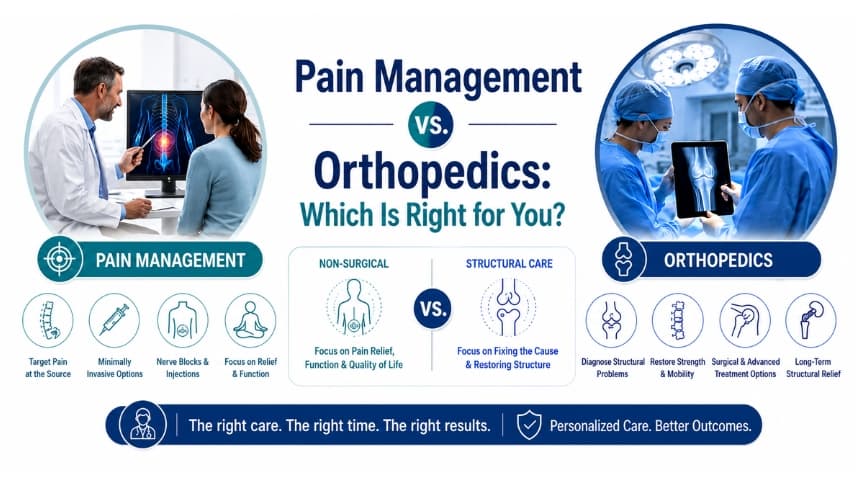
When persistent pain disrupts your daily life, knowing which doctor to call first can save you time, unnecessary procedures, and months of frustration. An orthopedic doctor and a pain management specialist both treat pain but they are trained differently, use different tools, and are suited to different clinical situations. If you are dealing with back pain, joint pain, neck pain, or chronic pain in the Dallas, TX area and are not sure where to start, this guide breaks down the key differences so you can make an informed decision about your care and take the right next step. An orthopedic doctor, or orthopedic surgeon, focuses on the structural components of the musculoskeletal system: bones, joints, ligaments, tendons, and cartilage. Their goal is to diagnose and correct structural damage. When something is physically broken, torn, or severely degenerated, an orthopedic specialist evaluates if surgery, immobilization, or another structural intervention is appropriate. An orthopedic doctor in Dallas TX typically treats: Fractures and post-fracture recovery Torn ligaments and tendons, such as ACL or rotator cuff tears Knee and hip arthritis requiring joint replacement evaluation Spinal deformities, including scoliosis Sports injuries involving structural joint damage A pain management doctor, also called a pain specialist or interventional pain physician, focuses on diagnosing and treating pain itself. Their training often comes from anesthesiology, physical medicine and rehabilitation, or neurology, with advanced fellowship training in pain medicine. Rather than correcting structural damage surgically, a pain specialist works to identify the source of pain signals and interrupt or reduce them using targeted, minimally invasive procedures. A Dallas pain management specialist may be a better fit for: Chronic back pain and lumbar radiculopathy (nerve pain traveling into the leg) Neck pain from herniated discs or degenerative disc disease Neuropathic pain: burning, stabbing, or shooting sensations from nerve involvement Sciatica and spinal stenosis Sacroiliac joint dysfunction Complex regional pain syndrome (CRPS) Joint pain and arthritis that has not responded to conservative care The most useful way to think about this comparison is simple: orthopedic doctors treat structural damage, while pain management doctors treat pain that is persistent, nerve-related, or does not clearly require surgical repair. Orthopedic surgeons can perform surgery. Pain management specialists typically do not operate but offer a broader set of non-surgical, interventional options, including epidural steroid injections, radiofrequency ablation (RFA), medial branch nerve blocks, and spinal cord stimulation. These are often faster to access, lower in risk, and do not involve the recovery timeline of surgery. “Call 469-562-4188 to schedule a consultation with Dr. Rao K. Ali and take the first step toward the best care.” An orthopedic evaluation may be the right first step when your pain or injury appears to involve a clear structural problem. This is especially important if imaging or a prior medical opinion suggests that surgery, joint replacement, or another corrective procedure may need to be discussed. You may need to see an orthopedic doctor if: You experienced a clear trauma: a fall, collision, or sports injury X-ray or MRI shows a fracture, torn ligament, or significant joint degeneration A physician has already told you that joint replacement may be necessary You have a spinal deformity or instability that may require surgical correction Conservative care has failed and your structural imaging supports a surgical candidate evaluation A pain management specialist may be the best first step when your pain has lasted for weeks or months and does not clearly point to a surgical problem. This type of specialist focuses on identifying the source of pain, reducing symptoms, and exploring non-surgical treatment options before more invasive procedures are considered. You may need to see a pain management specialist if: Your pain has lasted more than 12 weeks, the threshold commonly used to define chronic pain Your pain is nerve-related: burning, radiating, shooting, or tingling sensations Imaging does not show a structural cause that clearly warrants surgery You have already tried physical therapy or anti-inflammatory medications without meaningful relief Your primary care provider has referred you to a specialist for pain management You are exploring non-surgical options before committing to an operation One important reality competitors rarely discuss is that surgery does not always eliminate chronic pain. Some patients who have undergone spine surgery, joint replacement, or other orthopedic procedures continue to experience significant pain. This is sometimes called failed back surgery syndrome (FBSS) or persistent post-surgical pain. In these situations, a pain management specialist becomes essential, not as a last resort, but as the most appropriate provider for treating nerve sensitization, spinal cord signaling changes, and regional pain that surgery cannot resolve. Pain management is frequently the right next step after orthopedic care has treated the structural problem. At Premier Pain Centers, Dr. Rao K. Ali, a board-certified pain management specialist offers a range of evidence-supported procedures, including: Epidural steroid injections: reduce inflammation around compressed or irritated spinal nerves Medial branch blocks and radiofrequency ablation (RFA): interrupt pain signals from the facet joints of the spine Nerve blocks: target specific nerves responsible for regional pain, including neck and back Spinal cord stimulation (SCS): modulate pain signals in complex chronic pain or failed back surgery cases Sacroiliac joint injections: Treat pain from the SI joint connecting the spine to the pelvis Joint injections: reduce inflammation and improve function in the knee, shoulder, or hip Medication management: coordinate appropriate pharmacological support alongside procedural care When looking for a pain specialist in Dallas, TX, choose a provider with board certification, interventional pain expertise, and a patient-focused approach. The right specialist should evaluate your symptoms, medical history, imaging, and treatment goals, not just one test result. Premier Pain Centers offers pain management care for back pain, neck pain, joint pain, nerve pain, and chronic conditions. To discuss if interventional pain management is best for you, call 469-562-4188 to schedule an evaluation. There is some overlap. Pain management doctors treat back pain, neck pain, joint pain, and nerve pain, but they do not perform surgery. If your condition needs joint replacement, spinal fusion, or another surgical correction, an orthopedic surgeon is the best provider. Many patients benefit from coordinated care between both specialists. Many practices, including Premier Pain Centers, accept both referrals and self-referred patients. Requirements depend on your insurance plan, so it is best to confirm coverage before scheduling. Call 469-562-4188 to discuss your situation. Yes, a pain specialist consultation can be a reasonable step before surgery. A pain doctor may evaluate non-surgical options such as epidural injections, RFA, or spinal cord stimulation to see if they can help reduce pain or delay surgery. Interventional pain management targets the source of pain with procedures such as injections, nerve blocks, radiofrequency ablation, and spinal cord stimulation. Medication may be part of care, but the goal is to treat the cause, not only manage symptoms. Many procedures, including epidural injections, nerve blocks, and RFA, may be covered when medically necessary. Coverage depends on your plan and diagnosis. Call 469-562-4188 to verify your benefits before your appointment.What Does an Orthopedic Doctor Actually Treat?
What Does a Pain Management Doctor Do Differently?
The Core Difference: Structural Repair vs. Pain Source Management
Signs You May Need to Start with an Orthopedic Doctor
Signs a Pain Management Specialist May Be the Right First Call
What Happens When Orthopedic Care Is Not Enough?
Interventional Pain Management Treatments Available in Dallas
Finding the Best Pain Specialist in Dallas, TX
Frequently Asked Questions
Can a pain management doctor treat the same conditions as an orthopedic surgeon?
Do I need a referral to see a pain management specialist in Dallas?
What if my orthopedic doctor has recommended surgery, should I see a pain specialist first?
How is interventional pain management different from just taking pain medication?
Does insurance cover pain management treatments in Dallas?