



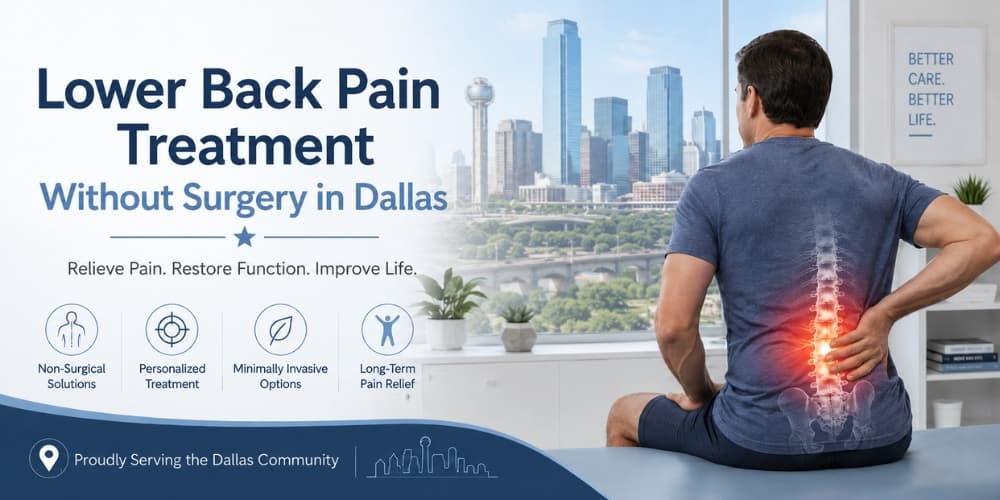
Lower back pain is soreness, stiffness, or pain felt in the lower part of the spine. It can happen because of poor posture, long sitting hours, heavy lifting, muscle strain, disc problems, arthritis, or nerve pressure. Many people look for lower back pain treatment without surgery in Dallas to get safe relief. Lower back pain can affect daily life by making walking, bending, driving, sleeping, and working difficult. It may reduce productivity, limit exercise, and cause frustration. According to the World Health Organization, around 619 million people worldwide were affected by low back pain in 2020, making it a very common condition. Non-surgical lower back pain treatment refers to medical, physical, and interventional approaches that relieve pain and restore function without an operation. These include conservative options like physical therapy and medications, as well as minimally invasive procedures such as epidural steroid injections and radiofrequency ablation. The goal is to reduce inflammation, calm irritated nerve roots, and improve lumbar stability, without cutting, fusing, or removing tissue. For the great majority of patients, non-surgical care is not a workaround. It is the primary treatment plan, and in many cases, it is the only one needed. Not all back pain comes from the same source, which is why effective chronic lower back pain treatment starts with an accurate diagnosis. Several conditions consistently respond well to non-surgical care: Muscle strain and ligament sprains are among the most common causes and typically resolve with NSAIDs (non-steroidal anti-inflammatory medications), rest, and targeted physical therapy. Degenerative disc disease, gradual wear on the cushioning discs between vertebrae, often stabilizes with core strengthening and activity modification. Lumbar facet joint arthritis, which causes localized stiffness and back pain, frequently responds to medial branch blocks or radiofrequency ablation (RFA) once conservative care has been tried. Spinal stenosis, a narrowing of the spinal canal that places pressure on nerves, may be managed effectively with epidural steroid injections and supervised physical therapy before any surgical discussion is warranted. Physical therapy is often the first recommendation for back pain relief without surgery because it does more than control symptoms. It helps correct poor movement patterns and muscle imbalances that may keep pain going. A structured program may include core stabilization exercises to strengthen the abdominal and paraspinal muscles that support and protect the lumbar spine. Flexibility exercises for the hip flexors and hamstrings can help reduce strain on the lower back during daily movement. Manual therapy, including joint mobilization, may also relieve stiffness in the sacroiliac or lumbar facet joints. Effective therapy can lead to stronger, longer-lasting pain relief when patients complete their full treatment plan. For personalized care from the best pain doctor in Dallas, call Dr. Rao K. Ali at 469-562-4188. For patients whose pain does not sufficiently respond to physical therapy, medications, and rest, there are effective interventional options that remain entirely non-surgical. These procedures are performed by a pain management specialist in Dallas using image guidance, typically fluoroscopy or ultrasound to target the precise anatomical source of pain. Epidural steroid injections (ESIs): Deliver anti-inflammatory medication near irritated spinal nerves and may help with sciatica, herniated disc pain, and spinal stenosis-related symptoms. Medial branch nerve blocks: Help identify and temporarily relieve pain coming from the facet joints in the spine. Radiofrequency ablation (RFA): Uses controlled heat to reduce pain signals from targeted medial branch nerves and may provide longer-lasting relief in selected patients. Sacroiliac joint injections: Target pain coming from the sacroiliac joint, where the lower spine connects to the pelvis. Sciatica pain treatment begins with identifying if the sciatic nerve is compressed by a herniated disc, bone spur, or spinal stenosis in the lumbar region. Lumbar radiculopathy, the clinical term for nerve root irritation that causes pain to radiate down the leg, is one of the most common presentations seen by pain management specialists. When nerve root compression is confirmed, an epidural steroid injection can meaningfully reduce inflammation and interrupt the pain cycle. Physical therapy focused on lumbar stabilization and nerve mobilization is often combined with injection therapy. The large majority of sciatica cases resolve without surgery. Patients experiencing progressive weakness, numbness affecting a broad area, or any loss of bladder or bowel control should seek immediate medical evaluation, as these can indicate a condition requiring urgent care. Treatment timelines vary by condition and approach. Acute lower back pain from muscle strain often improves within two to six weeks with physical therapy and NSAIDs. Chronic lower back pain, defined as pain lasting more than three months, typically requires a longer, layered plan, often four to twelve weeks of supervised therapy before interventional options are evaluated. Epidural steroid injections generally show meaningful results within one to two weeks after the procedure. Radiofrequency ablation typically provides relief within three to four weeks, with duration ranging from six months to two years depending on the nerve treated and the patient's underlying condition. A pain management specialist diagnoses and treats chronic or complex pain without immediately choosing surgery. If lower back pain lasts more than six weeks, does not improve with rest or over-the-counter medicine, or radiates down the leg, a proper evaluation is recommended. Early diagnosis can improve outcomes for lower back pain and sciatica treatment. For patients seeking non-surgical back pain treatment in Dallas, Dr. Rao K. Ali offers detailed evaluations and personalized treatment plans. Care may include physical therapy coordination or image-guided procedures based on the patient’s condition and history. To discuss treatment options, call 469-562-4188 or request an appointment online. Core exercises like bird-dog, dead bug, and modified planks can help. Walking is also useful because it keeps the spine moving without adding too much pressure. If pain lasts more than four to six weeks, see a doctor. Ongoing pain may be due to a disc issue, nerve pressure, or joint problem. Sleep on your side with a pillow between your knees, or on your back with a pillow under your knees. Avoid sleeping on your stomach. Mild back pain may improve in two to six weeks. Chronic pain lasting over three months may need a structured treatment plan. Treatment may include physical therapy, anti-inflammatory medicine, epidural steroid injections, or radiofrequency ablation. Surgery is usually considered only when non-surgical care does not work.What Non-Surgical Lower Back Pain Treatment Means
Common Lower Back Conditions That Respond Well to Conservative Care
Physical Therapy and Core Strengthening: The Starting Point for Most Patients
When Physical Therapy Is Not Enough: Interventional Options Without Surgery
Sciatica and Nerve Pain: Non-Surgical Treatment That Targets the Source
How Long Does Non-Surgical Back Pain Treatment Take to Work?
When to See a Pain Management Doctor in Dallas for Lower Back Pain
FAQs
What is the best exercise for lower back pain?
What if my back pain is not going away?
How should you sleep with lower back pain?
How long does lower back pain take to heal?
How can lower back pain be treated without surgery?