



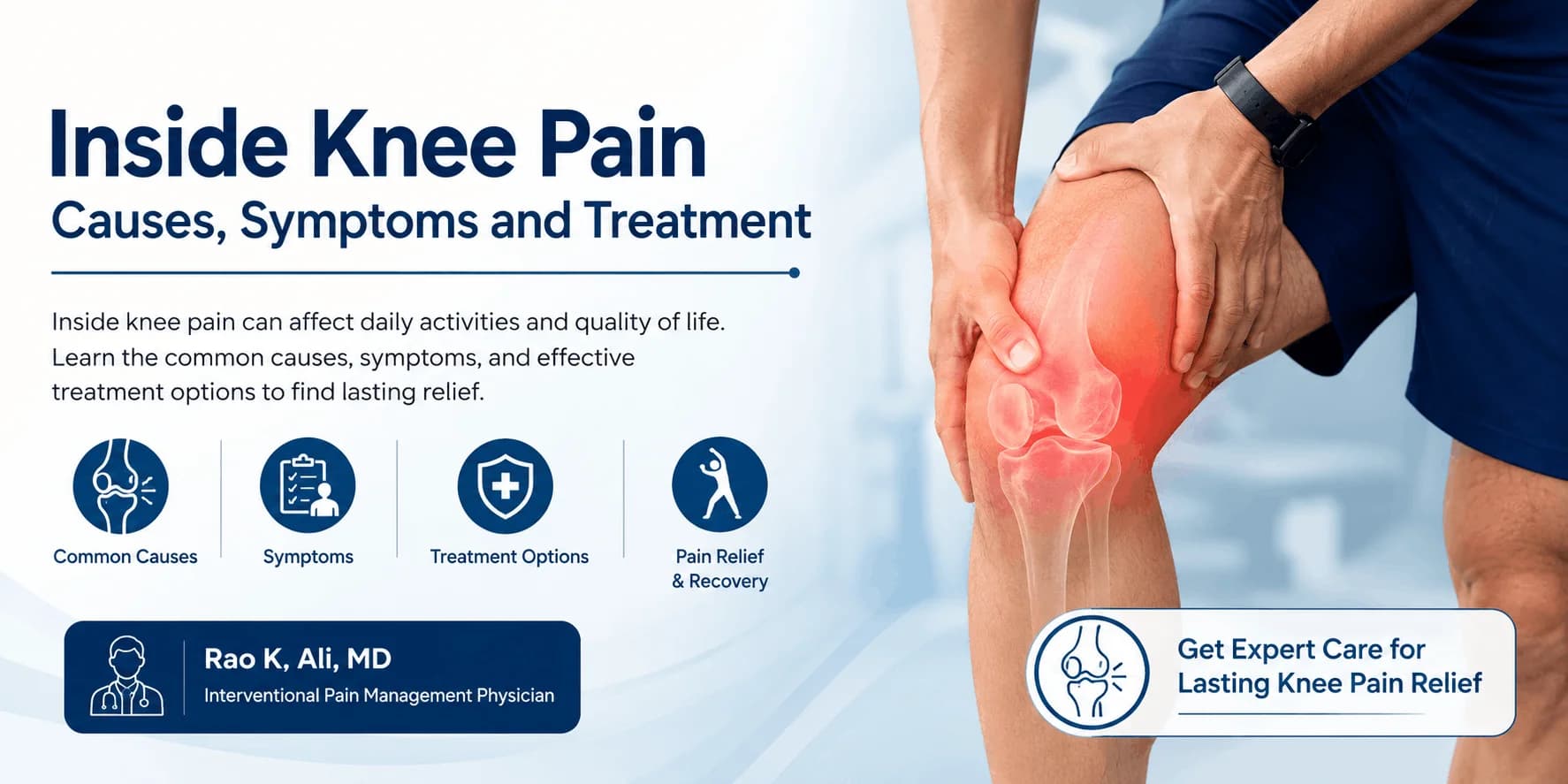
Pain on the inner side of the knee can begin after a sudden twist, direct impact, repetitive exercise, or changes within the joint over time. The painful area may involve the medial meniscus, medial collateral ligament, nearby tendons, a small fluid-filled bursa, or the cartilage protecting the knee bones. Finding the exact cause is an important part of inside knee pain treatment. Knee pain can make it difficult to walk, climb stairs, stand from a chair, exercise, drive, sleep, or complete normal work activities. Frequent knee pain affects approximately one in four adults and can reduce mobility and quality of life. Dr. Rao K. Ali, an interventional pain management physician, evaluates knee pain to identify the cause and guide the right treatment plan. Inside knee pain, also known as medial knee pain, develops along the side of the knee closest to the opposite leg. It may feel like soreness, tenderness, stiffness, aching, or a sharp pain that becomes stronger during walking, bending, climbing stairs, or standing from a seated position. The pain may remain in one specific area or spread toward the kneecap, thigh, or upper shin. Inner knee pain can be linked to the meniscus, ligaments, tendons, bursa, or cartilage within the joint, so identifying the exact cause is important for choosing the best treatment. Pain on the inside of the knee can develop when the meniscus, ligaments, tendons, bursa, or joint cartilage becomes injured or irritated. A physical examination and medical history can help identify the exact source of pain. Below are the common causes of inner knee pain: The medial meniscus is a C-shaped piece of cartilage that cushions the inner part of the knee. It can tear during a pivot, deep squat, sudden turn, sports injury, or awkward movement. Degenerative tears can also develop as the tissue becomes weaker with age. A medial meniscus tear may cause: Pain along the inner joint line Swelling and stiffness Clicking, catching, or locking Difficulty fully bending or straightening the knee A feeling that the knee may give way The medial collateral ligament, commonly called the MCL, runs along the inside of the knee and helps stabilize the joint. An MCL sprain often occurs when a force hits the outer knee or the leg changes direction quickly. MCL injuries may cause inner knee tenderness, swelling, stiffness, instability, or a popping sensation during the injury. Mild and moderate MCL injuries can often be treated without surgery. The pes anserine bursa is located on the inner side of the upper shin, a few inches below the knee joint. Repetitive stress, running, muscle tightness, knee arthritis, and increased pressure on the joint can irritate this area. Pain from pes anserine bursitis usually develops below the inner knee instead of directly along the joint line. It may become worse during exercise, climbing stairs, or standing after sitting with the knees bent. Osteoarthritis develops when cartilage within the knee becomes damaged or worn. Pain may be stronger on the inner side when the medial compartment of the joint is affected. Common symptoms include: Morning stiffness Pain during walking or standing Swelling around the joint Reduced knee movement Grinding or cracking sensations Pain after sitting for an extended period Muscles and tendons around the hamstrings, quadriceps, and inner thigh help control knee movement. Sudden increases in exercise, poor movement mechanics, muscle weakness, or inadequate recovery may strain these tissues. This type of pain may appear during running, climbing, kicking, squatting, or changing direction. Rheumatoid arthritis, gout, infection, and other inflammatory conditions can cause knee pain, warmth, stiffness, and swelling. A hot, red, swollen knee accompanied by fever or chills requires urgent medical care because it may indicate a joint infection. The exact symptoms depend on the cause and severity of the condition. Common signs include: Tenderness along the inner knee Pain when walking or standing Pain during stairs or squatting Swelling around the joint Morning stiffness Pain after exercise Clicking or catching Knee instability Difficulty straightening the leg Pain when turning or pivoting Tenderness below the inner knee A healthcare provider may ask when the pain began, what movements increase it, and whether an injury occurred. The examination may include checking swelling, joint-line tenderness, range of motion, stability, leg alignment, muscle strength, and walking pattern. X-rays: X-rays can show fractures, changes in joint space, bone spurs, and signs of arthritis. They do not show a meniscus tear directly. MRI scan: An MRI provides detailed images of the meniscus, cartilage, tendons, ligaments, and other soft tissues. It is commonly used when a meniscus or ligament injury is suspected. Ultrasound: Ultrasound may help evaluate tendons, bursae, fluid, and certain soft-tissue conditions. Laboratory testing: Blood tests or joint-fluid testing may be needed when infection, gout, or inflammatory arthritis is suspected. Inside knee pain treatment depends on the diagnosis, pain level, activity demands, medical history, and degree of joint damage. The treatment options below may help reduce pain, improve movement, and support better knee function. Running, jumping, deep squatting, kneeling, and repeated stair climbing may increase symptoms. A temporary reduction in painful activities can give irritated tissues time to recover. Complete inactivity is not always necessary. A knee pain doctor in Dallas or physical therapist can help identify lower-impact movements that place less pressure on the knee. Ice may help reduce pain and swelling after an injury or activity flare. A cold pack can be wrapped in a thin towel and applied for up to 20 minutes at a time. Light compression and leg elevation may also help control swelling. Ice should not be placed directly on the skin. Physical therapy is an important part of many inner knee pain treatment plans. Therapy may focus on: Improving knee movement Strengthening the quadriceps and hamstrings Strengthening the hips and gluteal muscles Improving balance Correcting walking or running mechanics Reducing stiffness Supporting a safe return to activity A hinged brace may provide stability during recovery from an MCL injury. An unloading brace may reduce pressure on one side of an arthritic knee. Crutches or a cane may also be used for a limited period when walking places too much pressure on the joint. Topical or oral anti-inflammatory medication may help reduce pain in some conditions. These medicines are not safe for everyone and may cause stomach, kidney, heart, bleeding, or medication-interaction problems. Patients with kidney disease, heart disease, ulcers, blood-thinning medication, or other medical conditions should speak with a healthcare provider before taking anti-inflammatory medicine. A corticosteroid injection may reduce inflammation and provide temporary relief for arthritis, bursitis, or other inflammatory knee conditions. The injection site depends on the diagnosed source of pain. Repeated injections are not suitable for every patient. Frequency and potential risks should be discussed with the treating physician. The genicular nerves carry pain signals from the knee toward the brain. A diagnostic genicular nerve block may be used in selected patients with chronic knee arthritis pain or pain that remains after knee surgery. Temporary relief from the diagnostic block may help determine whether radiofrequency treatment could be useful. Radiofrequency ablation uses controlled energy to reduce pain signals from selected genicular nerves. It may be an option for chronic osteoarthritis-related knee pain that has not improved with medication, therapy, activity changes, or injections. Research reviews report meaningful pain reduction in many selected patients, though results and improvement in movement can differ. A pain specialist in Dallas must determine whether the procedure matches the patient’s diagnosis and health history. Surgery is not required for every case of medial knee pain. It may be discussed when the knee repeatedly locks, a major ligament injury causes instability, a repairable meniscus tear remains symptomatic, or advanced arthritis causes severe limitations. Possible procedures include: Arthroscopic meniscus repair Removal of unstable meniscus tissue Ligament repair or reconstruction Knee realignment procedures Partial knee replacement Total knee replacement Mild inner knee soreness from overuse may improve with rest, cold therapy, and gentle movement. Medical care is recommended if pain follows an injury, the knee feels unstable, or symptoms keep returning. Avoid forcing the knee straight, exercising through sharp pain, or playing sports if the knee locks or gives way. Medical evaluation is recommended when: Pain continues for several weeks Swelling keeps returning Walking becomes difficult Pain affects sleep or normal activities The knee repeatedly catches or locks Home care does not produce steady improvement Not every knee condition can be prevented, but several habits may reduce avoidable stress: Increase exercise intensity in small stages Warm up before sports Strengthen the hips, thighs, and hamstrings Use shoes that match the activity Avoid sudden changes in running distance Rest after painful activity Maintain a weight recommended for your health Use proper movement during squats and lifting Complete rehabilitation after a knee injury Pain on the inner side of the knee can come from cartilage, ligaments, tendons, bursae, arthritis, or inflammatory joint problems. Treating every case with the same home remedy may delay the correct diagnosis. An examination can identify the painful structure and determine whether physical therapy, medication, bracing, an injection, a nerve procedure, or surgical evaluation is appropriate. Early care can also help reduce repeated swelling, joint stiffness, instability, and limitations during daily activities. Common causes include a meniscus tear, MCL sprain, pes anserine bursitis, and knee osteoarthritis. The exact cause depends on symptoms and injury history. Walking can put pressure on an injured meniscus, ligament, tendon, bursa, or arthritic joint, which may increase inner knee pain. No. Arthritis, ligament injuries, bursitis, tendon strain, and gout can also cause pain on the inside of the knee. Mild pain may improve in a few days, while ligament, meniscus, or arthritis-related pain can take several weeks or longer. Yes. Many cases improve with rest, physical therapy, bracing, medication, or injections. Surgery is usually needed only for severe damage.What Is Inside Knee Pain?
What Causes Pain on the Inside of the Knee?
1. Medial Meniscus Tear
2. Medial Collateral Ligament Injury
3. Pes Anserine Bursitis
4. Knee Osteoarthritis
5. Tendon or Muscle Strain
6. Inflammatory Joint Conditions
Symptoms that May Occur with Inner Knee Pain
How Is Inside Knee Pain Diagnosed?
Imaging Tests
Inside Knee Pain Treatment Options
Activity Modification
Ice, Compression, and Elevation
Physical Therapy
Knee Braces and Walking Support
Pain and Anti-Inflammatory Medication
Image-Guided Knee Injections
Genicular Nerve Block
Genicular Nerve Radiofrequency Ablation
Surgery
Can Inside Knee Pain Be Treated at Home?
How Can Inner Knee Pain Be Prevented?
Get the Best Inside Knee Pain Treatment
Frequently Asked Questions
What is the most common cause of pain inside the knee?
Why does the inside of my knee hurt when walking?
Is inside knee pain always a meniscus tear?
How long does inner knee pain take to heal?
Can inner knee pain improve without surgery?