


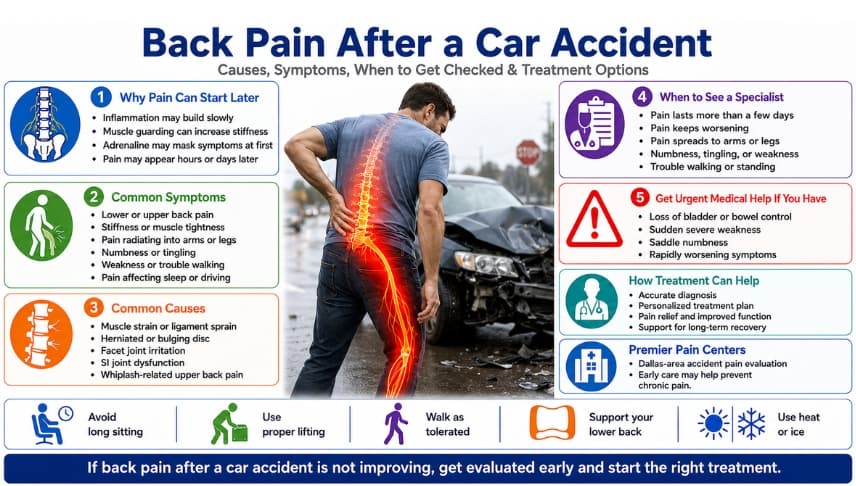
Back pain after a car accident should be taken seriously when pain is severe, worsening, radiates into the arms or legs, or comes with numbness, tingling, weakness, or difficulty walking. Delayed soreness may also need evaluation if it affects sleep, work, driving, or daily activity. For Dallas patients, the goal is to understand symptoms and get proper care when pain does not improve. At Premier Pain Centers, accident-related back pain is evaluated based on pain location, movement limits, nerve symptoms, spine history, and daily function. Treatment may include conservative care, medication review, physical therapy, image-guided injections, or other pain options when appropriate. Back pain can appear later because inflammation, muscle guarding, joint irritation, and nerve sensitivity may build slowly after the impact. Adrenaline after a crash may also mask symptoms at first, so pain that starts the next day or several days later should not be ignored. A car accident can create sudden acceleration, deceleration, twisting, compression, or bracing forces. These forces may affect the neck, thoracic spine, lumbar spine, pelvis, and surrounding soft tissues. Some patients feel pain immediately. Others notice stiffness, spasms, or radiating pain after the body’s initial stress response settles. A strain affects muscle or tendon tissue, while a sprain affects ligaments. These injuries may cause soreness, tightness, spasms, and pain with bending, twisting, lifting, or standing. Many soft-tissue injuries improve with conservative care, but persistent or worsening symptoms should be evaluated. A disc injury may irritate nearby nerves and can be associated with lower back pain after car accident, buttock pain, leg pain, numbness, tingling, or weakness. A herniated disc after a car accident does not always require surgery, but it may require medical evaluation when symptoms suggest nerve involvement. The facet joints are small joints in the spine that help guide motion. The sacroiliac joints connect the lower spine and pelvis. After a crash, either area may become painful with standing, extension, turning, or getting in and out of a vehicle. Diagnostic blocks or targeted injections may be considered when the exam suggests these structures are contributing to pain. Whiplash is usually discussed as a neck injury, but the same crash mechanics may also contribute to upper back pain after car accident, shoulder-area pain, headaches, or arm symptoms. Rear-end collisions are a common cause of whiplash-type injuries. When pain spreads into the arms or legs or comes with weakness or tingling, evaluation becomes more important. Sciatica describes pain that travels from the lower back or buttock into the leg because a lumbar nerve root is irritated or compressed. Patients may describe burning pain, electric pain, pins and needles, numbness, or weakness. Nerve symptoms after an accident should be documented and reviewed with a medical provider. Seek prompt medical evaluation if back pain after a crash is severe, getting worse, spreading into an arm or leg, or associated with numbness, tingling, weakness, difficulty walking, fever, or unexplained weight loss. Emergency care is important for bowel or bladder changes, saddle numbness, or major weakness. Not every ache after a crash is an emergency, but some patterns deserve fast attention. The following symptoms may suggest nerve irritation, spinal injury, infection, or another condition that should not be managed by guesswork. Pain that travels from the lower back into the buttock, thigh, calf, or foot Numbness, tingling, burning, pins and needles, or electric pain Weakness in the leg, foot, arm, or hand New difficulty walking, standing, gripping, or climbing stairs Severe spasms that limit basic movement Back pain with fever, unexplained weight loss, or feeling very ill Loss of bladder or bowel control, saddle numbness, or rapidly worsening weakness See a doctor after an accident if back pain is severe, persists beyond a few days, limits normal activity, radiates into the arms or legs, or comes with numbness, tingling, weakness, or walking difficulty. Early evaluation may help identify the pain source and guide safer treatment decisions. Dallas patients often delay care because they hope the pain will fade. Mild soreness may improve, but persistent pain can become harder to understand when weeks pass without documentation, exam findings, or a clear treatment plan. Dr. Rao K. Ali at Premier Pain Centers evaluates back pain, neck pain, sciatica, nerve-related pain, and chronic pain after injuries. As a double board-certified and dual fellowship-trained physician in Physical Medicine and Rehabilitation and Pain Medicine, Dr. Ali focuses on identifying the likely pain generator before recommending treatment. This may include a review of crash mechanics, prior medical history, symptom timing, physical exam findings, imaging reports, and response to earlier care. A pain management evaluation does not automatically mean an injection or procedure. It may clarify whether conservative care, physical therapy, medication adjustment, imaging review, or targeted interventional treatment should be considered. The right plan depends on the diagnosis, severity, neurologic findings, medical history, and patient goals. Use this framework as general guidance, not as a diagnosis. Go to the ER or seek emergency medical care for bowel or bladder changes, saddle numbness, major weakness, severe trauma, fever with back pain, chest pain, shortness of breath, confusion, or rapidly worsening neurologic symptoms. Schedule a medical evaluation when pain radiates into the arms or legs, numbness or tingling appears, pain worsens after 24 to 72 hours, or symptoms interfere with work, sleep, driving, or walking. This is where an accident injury doctor in Dallas may help clarify next steps. If soreness is mild, improving steadily, and not associated with nerve symptoms, conservative care and observation may be reasonable. However, if pain plateaus, returns, or begins limiting activity, schedule a provider visit rather than continuing to guess. A useful evaluation goes deeper than the term “back pain.” A back pain specialist in Dallas should ask where the pain is, how it started, what makes it better or worse, if it radiates, and if there are neurologic symptoms. Your provider may ask about the direction of impact, seatbelt use, airbag deployment, whether the car was drivable, immediate symptoms, delayed symptoms, previous spine problems, medications, and prior treatment. These details help place the pain pattern in context. A physical exam may include posture, range of motion, muscle tenderness, reflexes, sensation, strength, gait, and pain provocation tests. The exam may help separate muscle-dominant pain from nerve-dominant or joint-dominant pain. X-ray, MRI, or CT imaging may be appropriate when symptoms, trauma severity, neurologic findings, or red flags suggest a need for more information. Imaging is not always needed for every case of acute back pain, and findings must be interpreted alongside the exam because some disc or arthritis changes may exist before the crash. When the pain source is unclear, a specialist may consider diagnostic blocks in selected cases. These are not used for every patient, but they may help determine whether a facet joint, sacroiliac joint, or irritated nerve is contributing to ongoing pain. The back pain treatment in Dallas depends on the suspected pain source. A treatment plan for muscle spasm is not the same as a plan for nerve pain, disc-related leg pain, facet-mediated pain, or chronic pain after an accident. Gentle movement and guided rehabilitation may help many patients regain mobility. A provider may recommend avoiding prolonged bed rest while also limiting heavy lifting, twisting, or painful activity during the early recovery period. Medication may be considered for pain, inflammation, muscle spasm, or nerve-related symptoms, depending on the patient’s health history and risks. Patients should avoid combining medications or using someone else’s prescription without medical direction. Trigger point injections may be considered when localized muscle knots or spasms contribute to pain. They are not a cure for every accident-related injury, but they may help selected patients participate more comfortably in rehabilitation. An epidural steroid injection may be considered when an irritated spinal nerve is associated with radiating arm or leg pain. The goal is to reduce inflammation around the affected nerve and improve function when conservative care alone is not enough. Facet-related pain may worsen with extension, turning, or standing. A facet injection or medial branch block may be used diagnostically or therapeutically when the clinical picture suggests that spinal joints are a major contributor. The sacroiliac joint can contribute to low back, buttock, or pelvic-region pain after impact or altered movement. An SI joint injection may be considered when exam findings and pain location suggest SI joint involvement. Radiofrequency ablation may be considered for longer-lasting facet-mediated pain when diagnostic blocks suggest the targeted nerves are carrying the pain signal. It is generally not a first step immediately after every accident. For persistent nerve-related pain that does not respond to conservative and intermediate options, advanced treatments may be discussed in selected cases. These decisions require careful diagnosis, medical review, and a discussion of risks, benefits, and alternatives. Yes, back pain after an accident can become chronic, especially when pain persists beyond the expected healing window, nerve symptoms continue, movement remains limited, or the pain source is not clearly identified. Ongoing pain should be evaluated rather than managed only with repeated short-term fixes. Chronic back pain after accident injuries can affect sleep, work, driving, exercise, and mood. It may also create a cycle of reduced activity, stiffness, fear of movement, and worsening function. The goal of evaluation is to identify treatable contributors and create a plan that supports safer movement and long-term function. Clear symptom notes can help your provider understand the pattern. Before your appointment, write down: When the crash happened and when the pain started If pain is in the lower back, middle back, upper back, neck, buttock, arm, or leg If pain is sharp, dull, burning, electric, cramping, or stabbing Any numbness, tingling, weakness, headaches, dizziness, or walking difficulty What makes pain worse, such as sitting, standing, coughing, bending, driving, or lifting What helps, including rest, ice, heat, medication, stretching, or previous treatment ER records, imaging reports, medication lists, and prior spine diagnoses After a crash in Dallas or the surrounding DFW area, patients often need practical access to evaluation, follow-up, imaging review, therapy coordination, and pain treatment options. Local care may be especially useful when symptoms interfere with work, commuting, driving, or family responsibilities. Premier Pain Centers serves patients from Dallas, Richardson, Plano, Mesquite, DeSoto, Fort Worth, Waxahachie, and nearby communities. Patients with back pain after a car accident can call Premier Pain Centers to request an appointment and discuss whether an evaluation is appropriate for their symptoms. If back pain after a car accident is not improving, is spreading into your arms or legs, or is limiting sleep, work, walking, or driving, schedule an evaluation. Premier Pain Centers can review your symptoms and help determine whether conservative care, imaging review, physical therapy coordination, or interventional pain treatment may be appropriate. Call Premier Pain Centers at 469-562-4188 to request an appointment. Back soreness can happen after a crash, but that does not mean it should be ignored. Pain that is severe, worsening, radiating, or associated with numbness, tingling, weakness, or walking difficulty should be evaluated by a medical provider. Delayed pain may occur as inflammation, muscle spasm, stiffness, or nerve sensitivity increases after the initial stress response. Pain that starts later but keeps worsening or limits activity should still be taken seriously. See a doctor if pain is severe, lasts more than a few days, spreads into an arm or leg, causes numbness or weakness, or limits normal activities. Seek emergency care for bowel or bladder changes, saddle numbness, major weakness, or severe trauma symptoms. Not everyone needs an MRI. Imaging may be considered when symptoms, exam findings, trauma severity, or red flags suggest a need for more information. A provider can help decide whether X-ray, MRI, CT, or no immediate imaging is appropriate. Depending on symptoms, care may involve primary care, urgent care, emergency medicine, physical therapy, orthopedics, neurology, chiropractic care, or interventional pain management. For persistent spine, nerve, or sciatica symptoms, a pain management or spine-focused specialist may be appropriate. Yes. Whiplash commonly affects the neck, but the same motion may contribute to upper back pain, shoulder-area pain, headaches, stiffness, or arm symptoms. Severe pain or symptoms that spread into the arms should be evaluated. A car accident may aggravate or contribute to disc-related symptoms in some patients. A herniated disc may cause back pain, sciatica, numbness, tingling, or weakness. Imaging and exam findings are used together to decide whether the disc is clinically important. If pain persists for weeks or months, interferes with function, or keeps returning, schedule a more complete evaluation. Chronic accident-related back pain may involve muscles, discs, joints, nerves, or movement patterns that need a structured treatment plan.Why Back Pain Can Appear Hours or Days After a Crash
Muscle Strain and ligament Sprain
Herniated Disc or Bulging Disc
Facet joint or Si joint irritation
Whiplash and Back Pain
Nerve irritation and Sciatica
Symptoms that Should Not Be Ignored
When to See a Doctor for Back Pain After Accident
A Simple 3-Lane Decision Framework After a Crash
Emergency lane
Specialist Evaluation lane
Monitor and Follow-up lane
How a Dallas Back Pain Specialist May Evaluate Accident-Related Pain
Medical History and Accident Details
Physical Exam
Imaging When Appropriate
Diagnostic iInjections or Nerve Blocks
Treatment for Back Pain After Car Accident.
Activity Modification and Physical Therapy
Medication Review
Trigger Point Injections
Epidural Steroid Injection
Facet Joint Injection or Medial Branch Block
SI Joint Injection
Radiofrequency Ablation
Advanced options for chronic nerve-related pain
Can Back Pain After an Accident Become Chronic?
What to Track Before Your Appointment
Dallas Auto Accident Pain Treatment: Why Local Evaluation Matters
Book an Appointment for Back Pain After a Car Accident in Dallas
FAQs
Is Back Pain Normal After a Car Accident?
Why Did My Back Pain Start two Days After the Crash?
When Should I See a Doctor for Back Pain After an Accident?
Do I Need an MRI For Back Pain After a Car Accident?
What Type of Doctor Treats Accident-Related Back Pain?
Can Whiplash Cause Upper Back Pain?
Can a Herniated Disc Happen After a Car Accident?
What If My Back Pain Becomes Chronic?