



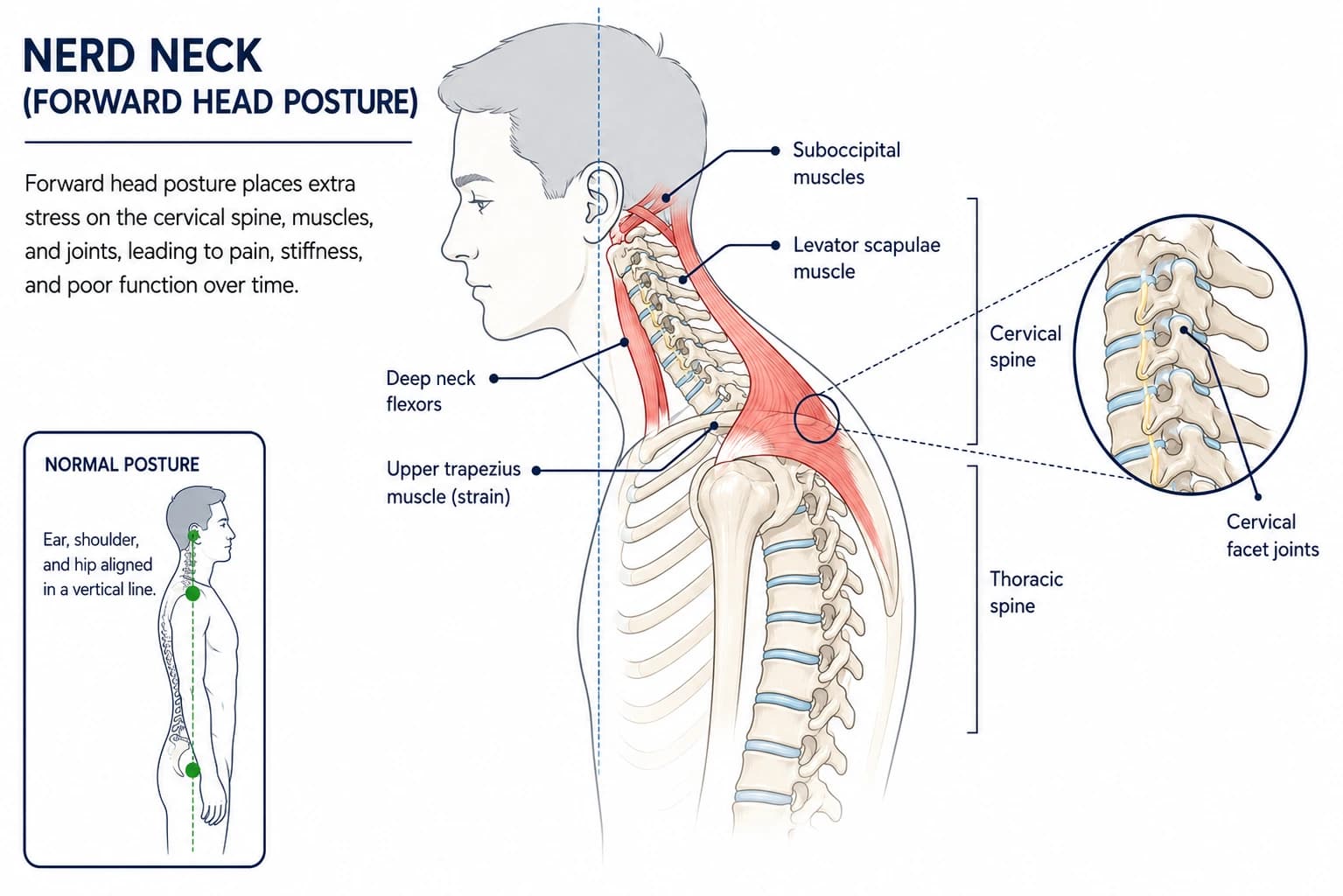
If you are searching for nerd neck treatment in Dallas, you are probably not worried about posture as a theory. You are worried because your head sits forward, your upper back looks rounded, your neck aches by the end of the workday, or you have started noticing a small "neck hump" in photos. Nerd neck, also called tech neck or forward head posture, can often improve with better habits, specific strengthening, and treatment for the pain generator when one is present. The important part is knowing which bucket you are in. Nerd neck is forward head posture caused by the head sitting in front of the shoulders instead of stacked over the spine. The neck muscles then work harder to hold the head up. That extra load can irritate muscles, joints, discs, and nerves, especially when the same posture repeats for months. We see this in clinics all the time a patient says, "My neck is killing me from my laptop," but the exam shows more than one issue. The screen posture started it. Then the upper trapezius, levator scapulae, suboccipital muscles, and cervical facet joints kept the pain going. The cervical spine is the neck portion of the spine. The thoracic spine is the upper and mid-back area. Nerd neck usually involves both. The head moves forward, the shoulders round, the upper back stiffens, and the muscles under the skull tighten. That is why the pain can show up as neck stiffness, upper-back burning, tension headaches, or pain between the shoulder blades. The limit is important. Posture does not explain every neck problem. A disc herniation, cervical radiculopathy, arthritis, fracture, inflammatory disease, tumor, infection, or spinal cord compression can also cause neck symptoms. Do not self-diagnose a serious neck problem as tech neck. Forward head posture treatment in Dallas should start with a clinical exam, not a posture brace from the internet. Most plans include ergonomic changes, deep neck flexor strengthening, shoulder-blade strengthening, chest stretching, and treatment for pain sources such as muscle trigger points, facet irritation, or nerve inflammation. The 2017 neck pain clinical practice guideline recommends neck range-of-motion exercise, scapulothoracic strengthening, endurance work, and selected manual therapy for common neck pain patterns. A Cochrane review found that strengthening and endurance exercises for the neck, shoulder, and upper-back region may reduce pain and improve function, but the evidence quality was not perfect. That is normal in musculoskeletal medicine. Patients still need a plan they can actually follow. A 2023 review on chronic neck pain with forward head posture found that treatment programs such as postural corrective exercises and manual therapy can improve pain and disability. It also pointed out the same limitation we see clinically: many studies are small, short-term, and not strong enough to promise permanent correction. That is the honest version. Exercises help many patients. Manual therapy can help some patients. Ergonomic changes matter. But if pain keeps returning, travels down the arm, or causes weakness, the problem is no longer just "sit up straight." The fastest way to think about tech neck is to sort symptoms into three buckets. Bucket 1 is a posture habit without nerve signs. Bucket 2 is a muscle, joint, or disc pain generator. Bucket 3 is a nerve or spinal cord warning sign that needs medical evaluation. This is the patient with stiffness after laptop work, a forward head position in photos, rounded shoulders, and soreness that improves with movement. There is no arm weakness, no numbness, no electric pain, no balance problem, and no recent trauma. For this bucket, treatment usually starts with daily posture correction and exercise. The basics are not exciting, but they work better than buying five devices and using none of them. Raise your monitor so your eyes meet the upper third of the screen. Use a separate keyboard and mouse if you work from a laptop for hours. Take a one- to two-minute movement break every 30-45 minutes. Train chin tucks, deep neck flexor endurance, rows, wall angels, and scapular retraction. Stretch pectoralis minor, upper trapezius, levator scapulae, and the front of the chest. Do not wear a posture brace all day unless your clinician recommends it. This is where a pain physician becomes more relevant. The posture may have started the problem, but now a specific structure may be driving pain. Common pain generators include myofascial trigger points, cervical facet joints, irritated discs, and inflamed nerve roots. Myofascial trigger points are tight, irritable bands of muscle that can refer pain into the head, shoulder, or upper back. Cervical facet joints are small joints in the back of the neck that can hurt with extension, rotation, or sustained poor posture. A disc problem may irritate a nerve root and send pain into the arm. We see this every week: someone says, "I just need my posture fixed," but they cannot turn their head to back out of the driveway, or they wake up at 3 a.m. with pain in the shoulder blade. That is not a posture reminder problem. That is a diagnosis problem. Call a physician promptly if neck pain comes with arm weakness, numbness, tingling into the fingers, loss of grip strength, walking imbalance, clumsy hands, fever, unexplained weight loss, cancer history, recent trauma, or pain that is severe and worsening. Discuss urgent symptoms with your physician or seek emergency care when appropriate. These symptoms can point to cervical radiculopathy, spinal cord irritation, infection, fracture, or another condition that should not be managed by YouTube stretches. The earlier exam matters. Waiting six months while calling it tech neck can turn a fixable problem into a longer recovery. Tech neck treatment usually starts with three daily changes: raise the screen, move more often, and strengthen the neck and shoulder-blade muscles. Passive treatments may calm pain, but long-term improvement usually requires the patient to retrain the posture that caused the strain. A practical plan is usually built around four to six weeks of consistent work. Some patients feel better sooner. Others need longer because the posture has been present for years, pain sensitivity is higher, sleep is poor, or the job keeps reproducing the same position. Start with the work setup. Your phone should not live in your lap. Your laptop should not be your full-time desktop. Your chair should support your back, but the chair will not save you if you sit still for eight hours. Movement is treatment. Then strengthen. The most useful exercise categories are deep neck flexor training, scapular stabilizer work, thoracic extension mobility, and chest stretching. In a six-week randomized trial of 60 women with neck pain and forward head/rounded shoulder posture, stabilizing exercises improved pain, function, and posture; adding manual therapy produced greater improvement in pain and function than exercise alone. The study was small, so use it as direction, not a guarantee. A "neck hump" can be posture-related rounding at the upper back, but it is not always just a nerd neck. It can also be related to kyphosis, osteoporosis-related vertebral compression, body-fat distribution, skin or soft-tissue changes, medication effects, or structural spine disease. That is why the wording matters. If the hump is mainly from rounded shoulders and forward head posture, the plan often focuses on thoracic mobility, shoulder-blade strength, chest stretching, and work-station changes. If the hump is rigid, painful, worsening, or associated with height loss or fracture risk, it needs medical evaluation. Do not let a social media posture account diagnose that from a photo. For patients searching "neck hump treatment Dallas," the best answer is not a promise to erase the hump. The best answer is to identify the cause, treat pain if pain is present, and refer to the right specialist when the issue is structural, metabolic, or cosmetic rather than pain-driven. Many patients with mild tech neck do not need injections. They need exercise, better ergonomics, and time. A pain physician becomes more relevant when pain is persistent, function is limited, conservative care has failed, or the symptoms suggest a specific pain generator. Dr. Rao K. Ali evaluates whether the pain is mostly muscular, joint-related, disc-related, nerve-related, or coming from another source. That matters because the wrong treatment wastes time. A trigger point injection will not fix a compressed nerve. A cervical epidural steroid injection is not a posture correction tool. Radiofrequency ablation is not for a simple tight trapezius. The diagnosis comes first. Patients should consider a pain management evaluation when: Neck pain lasts more than four to six weeks despite home care or therapy. Pain returns every time you work at a desk or drive. Pain radiates into the shoulder, arm, hand, or fingers. You have numbness, tingling, weakness, or grip changes. Headaches seem to start from the neck or base of the skull. You have already tried chiropractic care, massage, ibuprofen, acetaminophen, posture braces, or YouTube exercises without durable improvement. You need a physician to review imaging, medications, procedures, or a work-injury/personal-injury treatment plan. The first visit should not feel like a lecture about sitting straight. It should begin with a careful exam. Dr. Rao K. Ali may review where the pain started, what makes it worse, what helps, if symptoms travel into the arm, and if there are signs of nerve involvement. For people searching for the best pain doctor in Dallas, this type of detailed evaluation matters because neck pain can come from muscles, joints, discs, nerves, posture strain, or referred pain from nearby areas. The evaluation may include posture observation, cervical range of motion, shoulder and upper-back mechanics, muscle tenderness, trigger point assessment, neurologic testing, reflex checks, strength testing, sensation review, and X-ray or MRI review when clinically appropriate. Imaging is not automatic. It is most useful when the exam suggests a structural issue, nerve compression, long-lasting symptoms, or red flags that need closer medical attention. Treatment depends on the pain generator. A patient with posture-related muscle pain is not treated the same way as a patient with cervical radiculopathy. This is the base layer for most patients. A plan may include chin tucks, deep cervical flexor endurance work, rows, band pull-aparts, thoracic extension, doorway chest stretches, scapular strengthening, and workstation changes. The plan should be specific enough that the patient knows what to do Monday morning. For some patients, short-term use of acetaminophen, NSAIDs such as ibuprofen or naproxen when safe, topical diclofenac, lidocaine 5% patches, or a short course of muscle relaxant may be discussed. These choices depend on medical history, kidney function, stomach bleeding risk, blood thinners, age, and other medications. Discuss these with your physician. If painful muscle knots are a major driver, trigger point injections may help calm the muscle enough to allow therapy and movement. They do not correct their posture by themselves. They are a tool for pain control when the exam supports myofascial pain. If pain seems to come from cervical facet joints, a physician may consider diagnostic medial branch blocks. If those blocks produce the expected temporary relief, radiofrequency ablation may be discussed for longer relief. This pathway is for joint-mediated neck pain, not for simple screen posture. If pain travels into the arm with signs of nerve root irritation, and imaging/exam support cervical radiculopathy, a cervical epidural steroid injection may be considered. This is not first-line for every tech neck patient. It is reserved for a different bucket: nerve inflammation or compression. Some patients need physical therapy. Some need a spine surgeon. Some need primary care workup for osteoporosis, inflammatory disease, medication effects, or other medical causes of kyphosis or neck shape changes. A good plan knows when to refer. Do not believe any ad that promises a permanent posture fix in one visit. Do not believe that cracking the neck reverses years of posture. Do not believe that a brace fixes the muscles it is replacing. And do not believe that every neck hump is the same condition. The realistic goal is pain reduction, better function, safer movement, stronger support muscles, and fewer flare-ups. Cosmetic posture changes may happen, but they should not be sold as a guarantee. If your neck pain keeps returning, your head posture is getting worse, or symptoms are moving into the shoulder, arm, or hand, schedule an evaluation with Dr. Rao K. Ali. Call 469-562-4188 to request an appointment. Many cases can improve with ergonomic changes, strengthening, stretching, and treatment of the pain source. The amount of correction depends on how long the posture has been present, whether the spine is flexible, and whether there is an underlying medical condition. Most people use the terms the same way. Nerd neck, tech neck, text neck, and forward head posture all describe the head sitting too far forward, often from phone, laptop, desk, or driving posture. Some patients feel less pain within four to six weeks of consistent exercise and ergonomic changes. Visible posture change can take longer. Long-standing stiffness, nerve pain, arthritis, poor sleep, and repeated desk strain can slow progress. A posture-related upper-back rounding can look like a neck hump, especially with forward head posture and rounded shoulders. But a hump can also come from kyphosis, osteoporosis-related compression, body-fat distribution, or structural spine disease. A clinician should evaluate a rigid, painful, or worsening hump. If symptoms are mild and only posture-related, physical therapy or supervised exercise may be enough. If pain persists, radiates into the arm, causes numbness or weakness, or does not respond to conservative care, a pain physician can evaluate the pain generator and imaging needs. Not automatically. Many posture-related neck pain cases start with history, exam, and conservative care. MRI becomes more relevant when symptoms persist, radiate into the arm, include weakness or numbness, follow trauma, or raise concern for a structural problem. Injections may help selected patients when the exam suggests trigger points, facet joint pain, or nerve root inflammation. They do not fix posture by themselves. They are used when a specific pain generator is present and should be discussed with your physician. A posture brace can remind some patients to sit upright, but it should not replace strengthening. Overusing a brace may let the support muscles stay weak. Ask your clinician how often to use one, if at all.What Nerd Neck Means and Why It Hurts
Forward Head Posture Treatment Dallas Patients Should Understand
The 3-Bucket Test: Posture Habit, Pain Generator, or Nerve Warning
Bucket 1 - Posture Habit Without Nerve Signs
Bucket 2 - Muscle, Joint, Or Disc Pain Generator
Bucket 3 - Nerve Warning Signs That Need Medical Evaluation
Tech Neck Treatment Starts With What You Do Every Day
Neck Hump Treatment: When It Is Posture and When It Is Not
When Neck Pain Treatment in Dallas TX Needs a Pain Physician
What Dr. Rao K. Ali May Check During an Evaluation
Treatment Options That May Be Used
Exercise, Physical Therapy, And Ergonomic Retraining
Medication Options For Short-Term Symptom Control
Trigger Point Injections For Myofascial Pain
Cervical Facet Or Medial Branch Procedures
Cervical Epidural Steroid Injection For Nerve-Related Pain
Referral When The Problem Is Not Pain-Management-Only
What Not to Believe About Nerd Neck
Schedule a Neck Pain Evaluation in Dallas
FAQ
Can nerd neck be fixed?
Is nerd neck the same as tech neck?
How long does it take to improve forward head posture?
Can a neck hump come from looking down at a phone?
Should I see a chiropractor, physical therapist, or pain doctor for tech neck?
Do I need an MRI for nerd neck?
Can injections help tech neck pain?
Is a posture corrector brace worth using?